
Common Mistakes Students Make in IGNOU MCom Projects and How to Avoid …
페이지 정보

본문
A IGNOU MCom project looks manageable as students begin reading the book. One report, a fixed layout, only a couple of chapters and a clearly defined submission deadline. Many students think it will be similar in format to assignments that they've completed. The confusion starts once the actual work begins.
The majority of project issues aren't in the realm of effort or intelligence. They result from tiny, repeated mistakes that slowly compromise the project. These mistakes are common as they are predictable, easy to spot, and easy to fix. However, every year hundreds of IGNOU MCom students repeat them and have to face delays or revisions.
Knowing these mistakes early will help you save time, money and stress.
When choosing a topic, do not check the whether it is practical
One of the earliest mistakes is at the topic choice phase. Students select topics that sound interesting however are difficult to carry out.
Certain topics are too general. Some require information that is not available. Certain depend on organizations that refuse to allow access. Later, students decrease size randomly or fight to prove weak data.
An ideal MCom topic for a project is not about the complexity. It's about a feasibility. It should match available time in terms of data access and students' understanding.
Before they decide on the final topic, students should ask one simple question. Could I do this using the resources I have.
Writing vague objectives that guide the direction of nothing
Objectives are meant to guide the project in its entirety. There are many IGNOU MCom projects, objectives are drafted to make space.
Students write general statements such as to analyze impact or analyze performance but without defining the subject matter being studied. They are not able to assist to determine the right methodology or analyze.
When the goals are unclear, each chapter gets a little muddled. Data collection feels random. Analysis lacks direction.
Clear objectives function as the map. Without them, even the best data feels useless.
The review of literature is treated as copied content
Another mistake to avoid is to copy a literature review from web pages, old projects or repositories on the internet. Students think that a long literature review indicates a high-quality project.
IGNOU MCOM project synopsis [pasarinko.zeroweb.kr] examiners look for understanding rather than volume. They expect students to make connections between earlier studies with their current topic.
Literature reviews should provide the research that has been conducted and explain how the present project can be placed. Research studies that do not provide an explanation show that there is no engagement.
Doing a rephrasing without understanding raises the risk of plagiarism when students don't plan to copy.
Insufficient explanation of method
Methodology is the area where students find themselves in panic. They know what they did but are unable to explain it academically.
A few chapters of methodology are copied from other publications without comparing it with their own work. This causes a mismatch between the objectives information, method, and data.
Methodology should clarify why a choice was made, what data was gathered, and the process of analysis. It doesn't need to be a complicated terminology. It just requires clarity.
Simple and truthful methods is always better than simple copied methods.
Data collection that is not relevant
Students will sometimes gather data since it's accessible but not to meet goals. Surveys are conducted without the proper structure. There is no connection between the questions and research objectives.
Then, in the process of analysis, students are challenged to interpret the results effectively. Charts are nice, but conclusions are a bit forced.
Data should aid the work and not be used to embellish it. Each question should be linked to at minimum one goal.
Good projects require less data and explain the process well.
A poor interpretation of results
Lots of IGNOU MCom projects include tables or graphs, yet they do not explain what they display. Students think that figures speak for themselves.
Examiners expect interpretation. What can this percentage tell us. Why is this trend so important. What is the relationship between it and the goals.
Repetition of numbers in words is not interpreting. The process of explaining meaning is.
The weak interpretation makes the entire analysis chapter feel void.
Doing nothing to comply with IGNOU format guidelines
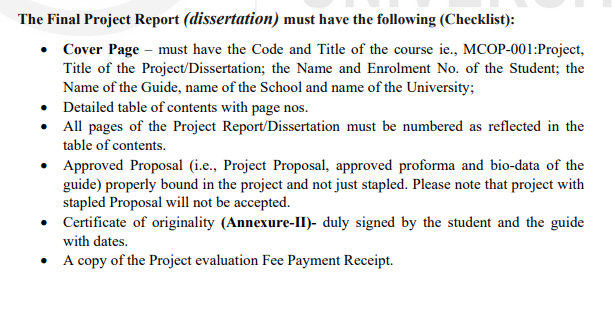
These mistakes can be minor but costly. Poor font sizes, incorrect spacing, missing certificates, or wrong chapter order create problems in the submission process.
Some students correct the format only after the fact, which creates rushed mistakes.
IGNOU Format guidelines should have been followed right from the beginning. This reduces time, and also prevents last minute panic.
Good formatting also makes the project easier to comprehend and analyze.
Hurrying to the conclusion chapter
The final chapter is typically written in a rush. Students often summarize chapters rather than providing conclusions.
A clear conclusion should explain what was observed, not what was written. It should connect findings to objectives and suggest practical implications.
Unsatisfactory conclusions make the project feel unfinished, even if earlier chapters are decent.
Insisting too much on the late-night fixes
Many students hold off on their project work believing that it can be completed quickly. Research writing is not done as such.
Last minute writing leads to mistakes made with care, poor research, and even formatting issues.
A steady pace with small events reduces pressure while improving the quality of work.
Fear of having to ask for it.
Some students may be reluctant to seek assistance. They think asking questions shows insecurity.
Academic projects require supervision. Mentors, supervisors, as well as academic aid are available for reasons.
Making sure you are clear about any doubts before they become bigger errors later.
Needing help with your project from ignou to improve understanding and structure is not unethical. It is practical.
Help with understanding academics
There is a lack of clarity between the two. There is a mismatch between guidance and unethical practices. Academic support that is ethical helps students recognize their needs, enhance their language and organize work.
It does not produce content or data.
Students who receive guidance understand their projects better and are more confident during evaluation.
We are not examining the entire project it is
Students typically focus on chapters on their own, but don't read all of the work together. It can result in inconsistent, repetitive, and the mismatch.
Going through the entire work once uncovers mistakes and omissions which otherwise are missed.
This easy step increases overall coherence substantially.
Affordance to learning from these mistakes
Making sure you avoid common mistakes will do more than ensure approval. It assists students to understand the basics of research.
The MCom project is usually the very first research experience. Being able to handle it appropriately builds confidence in future research.
Students who have learned about research discipline during MCom benefit in higher education and professional assignments.
A realistic thought to conclude
IGNOU MCom projects do not fail because students are incapable. They fail due to students being ignorant of the expectations.
Most errors are routine and they are easily prevented. Planning, awareness, and guidance make a significant difference.
If students are focused on clarity instead of complexity tasks become much simpler to complete and easier to review.
That is how IGNOU MCom projects should be tackled, calmly, effectively as well as with a solid understanding.
- 이전글Nine Tips To Begin Building A Electronics You Always Wanted 26.01.13
- 다음글Guide To Minimalist Fireplaces: The Intermediate Guide To Minimalist Fireplaces 26.01.13
댓글목록
등록된 댓글이 없습니다.